

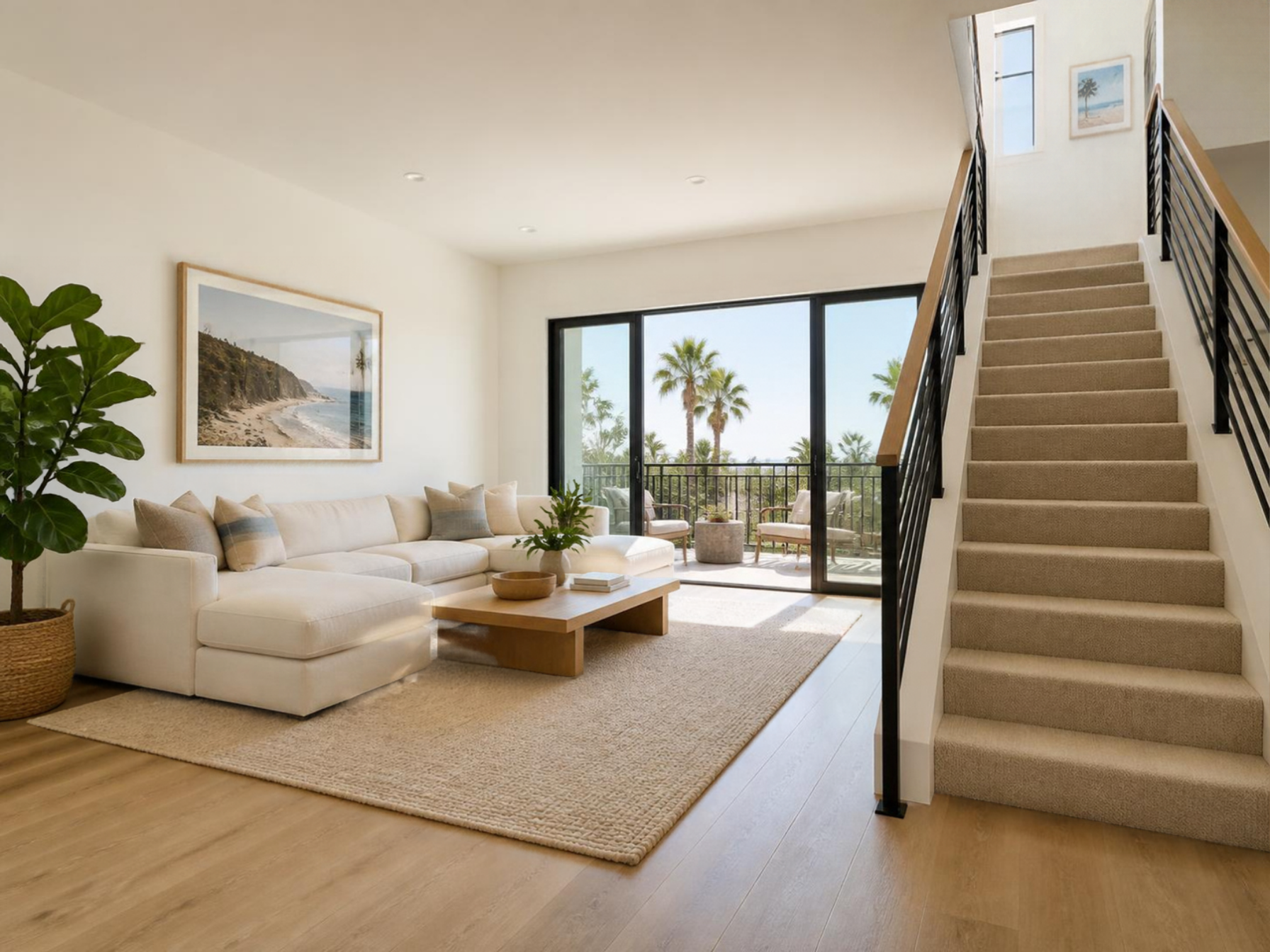
If the goal is keeping footsteps from reaching the people below, carpet over a good cushion is the quietest floor you can put down, and by a wide margin. If you want a hard floor instead, it can still be quiet enough, but only with the right underlayment and a careful installation, and how well it works depends on what your building is made of. In a condo, check your HOA's flooring rules before you pick a color, because they may set a minimum the floor has to meet.
Below are the test numbers behind that answer, what the sound ratings on a product sheet actually mean, how concrete and wood-framed buildings change the picture, and how to choose floors for a condo, a townhome or an upstairs bedroom.
The quietest flooring for condos, ranked
The fairest comparison puts different floors on the same structure. Mohawk published exactly that for its Sound System Collection: third-party lab tests of carpet, vinyl, laminate and sheet vinyl, all on an 18-inch open-web wood truss floor with a 3/4-inch poured topping. The higher the IIC (Impact Insulation Class), the less footstep and impact noise reaches the room below.
| Floor, as tested | IIC on the same wood-truss floor | What it means below |
|---|---|---|
| Cut-pile carpet on a 7/16-inch rebond cushion | 74 to 76 | Far above the code minimum of 50 |
| The same carpet on a thinner 9/32-inch synthetic pad | 66 to 70 | Still well above 50; the cushion matters |
| 12 mm laminate on acoustic underlayments | 54 to 57 | Just above the line with the right underlayment |
| Luxury vinyl plank, with or without a pad | 46 to 54 | Straddles the line; details decide it |
| Glue-down sheet vinyl | 49 to 50 | Right at the line |
Two things stand out. Carpet with a cushion beat every hard surface by roughly 10 to 30 points, and the choice of cushion alone moved carpet by as much as 10. Among hard floors the spread is narrow, so for them the underlayment and the installation decide the result.
Hardwood was not part of that test, but older research from Canada's National Research Council found that concrete slabs finished with wood flooring give only slightly better impact attenuation than bare concrete. Without a resilient layer underneath, a hardwood floor adds very little for the neighbors.
Impact noise vs airborne noise: which one your floor controls
Noise between floors comes in two kinds, and flooring mainly affects one of them.
- Impact noise starts when something strikes the floor: footsteps, a dropped pan, a chair scraping back. It travels through the structure. IIC measures how well a floor-ceiling assembly stops it.
- Airborne noise is voices, TV and music moving through the air and then through walls and floors. STC (Sound Transmission Class) measures how well an assembly blocks it.
Your floor covering is on the side where impacts happen, so it has a large effect on IIC and a small one on STC. Mohawk's results show it plainly: while IIC ranged from the mid-40s to the mid-70s depending on the flooring, the STC of the same assembly stayed between 57 and 59 no matter what was on top. If your complaint is a neighbor's television, new flooring will not fix it; if it is footsteps, flooring is the first place to look.
Impact noise itself splits into two sounds, and they have different fixes:
- Clicks and taps. Hard heels, dog nails, dragged furniture and dropped objects on hard flooring produce high-frequency sound. The ASTM standard for rating this noise states that it is determined mainly by the floor topping, largely independent of the rest of the structure. This is where your flooring choice does the most good.
- Thuds and booms. Footfalls on lightweight floors produce low-frequency sound. ASTM added a separate low-frequency rating for it in 2021, designed to sit alongside IIC, and the NRC research notes that most of this energy is at low frequencies, sometimes below the range the IIC test measures. Soft flooring helps less with thuds, especially in wood-framed buildings.
What California condo rules require
For new buildings, section 1206 of the 2025 California Building Code sets the minimums for floors and walls between dwelling units:
| Noise type | Lab rating required | Field rating required |
|---|---|---|
| Impact (footsteps) | IIC 50 or higher (ASTM E492) | NISR 45 or higher (ASTM E1007) |
| Airborne (voices, TV) | STC 50 or higher (ASTM E90) | NNIC 45 or higher (ASTM E336) |
The impact requirement does not apply to floors over spaces not designed to be lived in, such as garages, mechanical rooms and storage areas. Field tests are measured in the finished building, where conditions vary from place to place, and the code sets a lower number for them.
Those code minimums describe how the building was designed. When you replace flooring in an existing condo, what applies in practice are your association's rules, which may include an acoustic requirement for hard flooring written as a lab or field rating or as an approved underlayment. Ask for the written rule before you shop, and ask two specific questions: is the number a lab rating or a field rating, and does it apply to the flooring product, the underlayment, or the whole assembly?
California law also sets the ground rules for how your HOA handles your request. Under Civil Code section 4765, the association's decision on a proposed change must be made in good faith, cannot be unreasonable, arbitrary or capricious, and must be in writing. A denial has to explain why and describe how to ask for reconsideration, and you are entitled to have the board reconsider it at an open meeting. Keeping your application specific, with the product, the underlayment and its test report, makes it easier for the board to say yes.
How to read the sound rating on a product sheet
Here is the part most product pages leave out: an IIC number belongs to a whole floor-ceiling assembly, not to the flooring alone. The same plank or underlayment tested on a different structure gets a different number. Mohawk notes that acoustical performance differs between concrete floors and open-web wood truss assemblies, and underlayment maker Amorim notes that a bare 6-inch concrete slab rates about IIC 28, while a bare wood-frame assembly typically rates around 30. The rest of the number comes from everything layered onto that structure, including the ceiling below.
Before you trust a rating, check these things on the test report:
- What was it tested on? A 6-inch concrete slab, an 8-inch slab, a wood truss with a poured topping, or wood joists? Numbers from different structures cannot be compared.
- Was there a ceiling underneath? A resiliently suspended ceiling below adds a lot; the NRC found ceilings like that can raise a concrete floor's rating by anywhere from four or five points to more than 30. Amorim points out that STC ratings in the 60s or 70s on an underlayment data sheet indicate a ceiling assembly was used in the test.
- Is it a lab number or a field number? Lab ratings (IIC, STC) and field ratings (FIIC, NISR and similar) are measured differently, and comparing one product's field result with another's lab result is not an accurate way to judge them.
- Is it a "delta" rating? A Delta IIC, measured under ASTM E2179, isolates how much the floor covering itself improves a concrete floor, measured against a reference bare slab rated IIC 28. It is the cleanest way to compare coverings for a concrete building. Amorim notes that in most cases a Delta IIC above 20 is needed to reach code-level results.
- Does it apply to your building at all? ASTM E2179 itself says its results should not be used to estimate performance on lightweight floors made of only one or two layers such as plywood or OSB. A Delta IIC earned on concrete tells you little about a wood-framed condo.
Finally, do not chase a couple of points. Mohawk notes that the ear cannot distinguish much difference between IIC ratings of 53 and 57 on a concrete slab. The type of floor, the cushion or underlayment under it, and the quality of the installation move the result far more than small differences between similar products.
Concrete condos vs wood-framed buildings: why the same floor sounds different
What your building is made of changes both the kind of noise you get and which fixes work.
Concrete buildings
In a building with concrete floors between units, hard flooring produces sharp high-frequency clicks and taps, and the NRC research describes these as the source of complaints about footsteps and moving furniture. The good news is that this is the noise a floor covering controls best. Soft, thick coverings raise the rating dramatically, and the NRC found that with carpet and underlay on a concrete floor, most occupants are not disturbed by footstep noise. A hard floor over concrete needs a resilient layer under it, either an attached pad or a separate acoustic underlayment, to get close to the same place.
Wood-framed buildings and multi-story houses
In a wood-framed building, footsteps come through as thumps and booms, and more of that low-frequency sound gets through than with concrete floors. The NRC research found that resilient floor coverings that significantly improve concrete floors are normally much less effective on joist floors with wood subfloors, because the IIC there is driven by low-frequency sound. Carpet and pad can still produce a high IIC on a joist floor, but the same research warns that such floors may draw complaints about low-frequency thumping if the floor and ceiling are too light.
For wood-framed floors, the ceiling below counts as much as the flooring above. The NRC found that the biggest factor is the total mass of the subfloor and ceiling layers, with each doubling of that mass adding about seven IIC points, and that gypsum board attached directly to the underside of the joists gives very poor impact attenuation. Resiliently mounted ceilings and heavier layers are construction projects, not flooring swaps, but they are the reason two wood-framed buildings can sound so different with identical floors on top.
If you do not know how your building is built, your HOA or property manager may have the construction documents. Knowing whether the floor under you is concrete or wood-framed tells you which of the fixes below will pay off.
Carpet, vinyl, laminate or hardwood: how each performs
Carpet and cushion
Carpet is the quietest choice for the people below and for you, since it also softens footsteps and echo inside your own rooms. The cushion is a big part of the result: in Mohawk's tests, the same carpet rated 74 to 76 on a thick rebond cushion and 66 to 70 on thinner synthetic pads. For bedrooms, upstairs hallways and stairs in a condo or townhome, it is hard to beat. Our carpet collection includes Karastan, Mohawk and SmartStrand styles, and our earlier piece on why carpet still wins for noise in multi-level houses goes deeper on pairing carpet upstairs with hard floors elsewhere.
Luxury vinyl plank
Luxury vinyl appeals in condos because it is waterproof and easy to live with, but it is thin, and the NRC research notes that vinyl coverings produce only small increases in IIC for that reason. In Mohawk's tests, vinyl planks landed between 46 and 54, with a pad adding up to about four points. That puts LVP right around the code line, so the pad, the underlayment and the structure underneath decide whether it passes.
Two practical points. First, many planks come with a pad already attached, and those are designed as a system: Mohawk's SolidTech instructions, for example, say planks with a pad attached cannot be installed over a separate underlayment. If your HOA requires a specific underlayment, check that the product allows it before ordering. Second, when comparing products, ask for the acoustic test report, not just a number from a brochure. Our luxury vinyl plank with built-in underlayment is a good place to start if you want the pad and plank in one.
Laminate
Laminate is thicker and more rigid than vinyl and is usually installed floating over an underlayment. In Mohawk's tests, 12 mm RevWood laminate on acoustic underlayments rated 54 and 57. The underlayment is the acoustic part of a laminate floor, so choose it for its test data, not as an afterthought. Floating hard floors can also sound hollow or clicky inside your own room, which a quality underlayment helps with. When you look at our laminate flooring, plan the underlayment at the same time, since it is the part your HOA will ask about.
Engineered hardwood
Hardwood by itself does little for the neighbors, as the NRC finding on wood over concrete shows, so in a condo it goes over an approved acoustic underlayment, either glued down or floated depending on the product and the HOA's rule. Engineered construction is the practical choice here because it can go directly over a concrete slab, while solid hardwood needs a plywood subfloor built up first; we cover that difference in detail in our guide to engineered vs solid hardwood in San Diego's coastal climate. Our engineered hardwood comes in oak, hickory, maple and walnut.
Installation details that make or break a quiet floor
A floor can have excellent test numbers and still disappoint if it is installed in a way that lets sound bypass the underlayment.
- Keep hard flooring off the walls. Impact energy mostly travels down, but a considerable amount moves sideways through the floor. Underlayment maker Ecore explains that if the flooring touches the walls, that energy passes into the studs and framing and on to other rooms. Leave the expansion gap the manufacturer specifies (1/4 inch for SolidTech, for example) and keep it clear.
- Do not let the baseboard sit on the floor. The NRC research says it is best if the baseboard does not contact the floor finish, because that contact gives sound energy a path around the resilient layer. Set trim slightly above the finished floor.
- Use perimeter isolation where it is required. Some acoustic underlayment systems include a foam isolation strip that runs along the base of the walls. If your HOA or the underlayment maker calls for it, it is part of the rated assembly.
- Follow the product's underlayment rules exactly. Doubling up pads, skipping a required underlayment, or using an unapproved one takes the floor outside what the manufacturer tested and allows.
- Remove what does not belong. Mohawk's SolidTech instructions require removing carpet, cushion vinyl and floating floors before installation, so plan for the tear-out in a carpet-to-hard-floor project.
- Choose the right installation method for the floor under you. Glue-down and floating installations behave differently on slabs and on wood subfloors; our article on floating vs glue-down floors in San Diego homes explains the structural side.
Installation, furniture removal, carpet disposal and carpet re-stretching are all part of our flooring services, so the same team can handle the old carpet, the underlayment and the new floor.
Multi-story houses, townhomes and ADUs
Inside a single house, the building code's sound requirements do not apply between your own floors; section 1206 covers separations between different dwelling units. That gives you freedom to choose, but the physics are the same, and in a wood-framed house the thumping described above is what you will hear.
What works in practice:
- Carpet where people walk over living space. Bedrooms and hallways above a living room or bedroom are the best places for carpet and a good cushion.
- Carpet on the stairs, which see constant foot traffic and carry sound through the whole house.
- Hard floors with underlayment upstairs if you prefer them, with area rugs in the rooms that sit above bedrooms. For bedrooms without carpet, our guide to choosing a quiet bedroom floor without carpet compares hardwood, laminate and underlayment choices.
- Save hard, waterproof floors for ground-level wet areas such as kitchens, laundry rooms and entries, where noise from above is not the issue.
If you are adding an ADU that shares a wall or floor with the main house, sound separation becomes part of the design, and the two ratings people mix up most are explained in IIC vs STC for a shared-wall ADU.
Which floor should you choose? A quick guide
| Your situation | Best choice for noise | Why |
|---|---|---|
| Condo bedroom or hallway above a neighbor | Carpet on a thick cushion | Highest IIC by a wide margin |
| Condo living area where you want a hard floor | LVP or laminate with a tested acoustic underlayment, or pad-attached LVP | Can reach the code-level rating when the whole assembly is right |
| Condo where you want hardwood | Engineered hardwood over an approved acoustic underlayment | Wood alone adds little; the underlayment does the work |
| Wood-framed building with thumping complaints | Carpet and pad upstairs; ceiling work below if possible | Low-frequency thuds respond to mass and ceilings more than to thin coverings |
| Two-story house, rooms over bedrooms | Carpet, or hard floor with underlayment plus area rugs | No code minimum, same physics |
| Stairs in a townhome or house | Carpet | Heaviest footfalls, sound carries through the house |
More questions about quiet flooring
Does a thicker vinyl plank make a quieter floor?
Less than you might expect. In Mohawk's tests on the same structure, a 2 mm glue-down vinyl without a pad rated 48, while 5.5 mm click planks without a pad rated 49 to 50. Adding a pad raised most planks by three or four points. Thickness helps a little; the cushion under the plank and the structure under the cushion matter more.
Will area rugs fix a noisy hard floor?
They help where they sit. A rug and pad are a soft covering, the kind of layer that most reduces clicks and taps, so a large rug in a living room or bedroom cuts footstep noise and echo across that area. They do not cover hallways and kitchens, and they will not satisfy an HOA rule written around a tested floor assembly.
Planning a quieter floor for your San Diego home
A quiet floor comes from three decisions made together: the right floor type for each room, a cushion or underlayment chosen for its test data, and an installation that keeps sound from slipping around it. If you are in a condo, start with your HOA's written flooring rule, then request a free estimate. We will measure your rooms, go over carpet, vinyl, laminate and engineered hardwood options against that rule, and quote the installation so you can bring a specific plan to your association.


